


Question
On which of the following floor does V live?
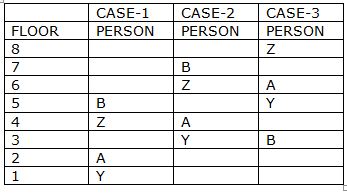 X lives on an even-numbered floor. The number of floors above X is the same as the number of floors below U. W lives three floors below V. The consecutive alphabetically named person doesn’t live on the adjacent floors of the building. Hence, cases 1 and 3 get eliminated.
More Coding Decoding Questions
- If ‘SOLVED’ is coded as ‘XVQCJK’, ‘RACING’ is coded as ‘WHHPSN’, then, ‘WATCH’ is coded as ____ in the same code language.
- What is the code for ‘future with happiness’?
- In a certain code language, "FIRE" is coded as 11, and "TEAM" is coded as 33. How will "HOPE" be coded?
- In a certain code language, ‘STATIC’ is coded as 196948 and ‘FUN’ is coded as 375. How will ‘FANTASTIC’ be coded in that language?
- If ‘to happen leap’ is written as ‘ mh st gs’ in the given code language, and ‘outcome review waited’ is written as ‘by zn cx’, then what is the code for ‘...
- In a certain code language, ‘890’ means ‘provided itself produce’, ‘825’ means ‘any for produce’ and ‘607’ means ‘change itself strength’. Which digit in t...
- What could be the code for “represent investigation designs confronted”?
- Find the odd one out?
- In a certain code language, ‘WATER’ is coded as ‘68’ and ‘EARTH’ is coded as ‘83’. How will ‘FIRE’ be coded in that language?
- If "BOTTLE" is coded as 34 and "GLASS" is coded as 27, how will "CUP" be coded?
Hey! Ask a query
Please enter email id
The email must be a valid email address.
Please enter Mobile Number
Please enter valid Mobile Number
Please enter your Doubt

Think You're Ready for RBI Grade B?
RBI Grade B 2026 Phase 1 Memory Based Paper
- 200 Questions with Detailed Solutions
- Section-wise Coverage (GA, English, Quant & Reasoning)