


Question
Statements: No Gold is a Silver. All Diamond are Silver. All Diamond are Bronze. Conclusions:
Statements: No Gold is a Silver. All Diamond are Silver. All Diamond are Bronze. Conclusions:
I. At least some Bronze are not Gold.
II. No Diamond is a Gold.
III. No Gold is Bronze.
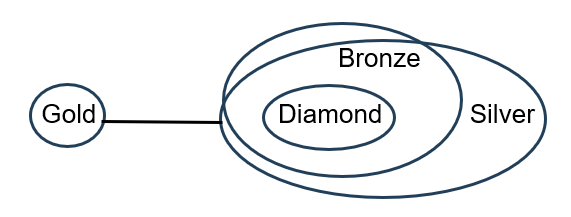 Alternative Method: All Diamond are Silver (A) → Conversion → Some Silver are Diamond (I) + All Diamond are Bronze (A) → Some Silver are Bronze (I). No Gold is a Silver (E) + Some Silver are Bronze (I) → Some Bronze are not Gold (O*). Hence conclusion I follows but conclusion III does not follow. All Diamond are Silver (A) + [No Gold is a Silver (E) → Conversion] → No Silver is a Gold (E) → No Diamond is a Gold (E). Hence conclusion II follows.
More Appropriate Paragraph Questions
- How will "Keep Fear From" will be coded in the given language?
- Select the option that is related to the fifth term in the same way as the second term is related to the first term and the fourth term is related to the t...
- Statements: Only Song are Lyrics. Some Song are Music. All Music are Composer. Conclusion: I. All Song are Composer is a possibility. II. Some Lyrics are M...
- Select the related number from the given alternatives: 12 : ? :: 11 : 1332
- Which of the following terms will replace the question mark (?) in the given series? ABC, ZYX, BCD, YXW, CDE,?
- Four words have been given, out of which three are alike in some manner and one is different. Select the odd one out.
- In a certain code language, ‘AFFORD is coded as 866513 and ‘ORGAN’ is coded as ‘51489’. How will ‘DRAGON’ be coded in that language?
- One of the key arguments in support of damming rivers across geographies has been the idea that useful water will otherwise ‘go waste into the sea’. Dam, d...
- Statement: Few A are B All A are D All B are C Conclusion: I. Some A are C II. Some D are B III. All B can be D
- Sumit starts from his house and walks 4 km towards north. Then he turns right and walks 2 km and then turns right and walks 6 km, then turns right and walk...
Relevant for Exams:
Hey! Ask a query
Please enter email id
The email must be a valid email address.
Please enter Mobile Number
Please enter valid Mobile Number
Please enter your Doubt

Think You're Ready for RBI Grade B?
RBI Grade B 2026 Phase 1 Memory Based Paper
- 200 Questions with Detailed Solutions
- Section-wise Coverage (GA, English, Quant & Reasoning)