


Question
Quantity I: A student multiplied a number by 3/5 instead of 5/3. What is the % error in the calculation? Quantity II: The population of a town is 2,34,000. 4/9 of them are males and rest are females. If 30% of males are married and number of married females is 2.5 times of married males. Find the percent of married females out of total females in the town?
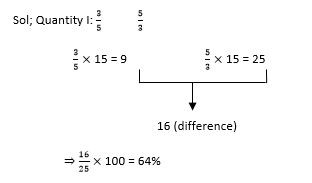 Quantity II: Number of males = 4/9× 2,34,000 = 1,04,000 Number of females = 2,34,000 – 1,04,000 = 1,30,000 Number of married males = 30/100×1,04,000 = 31,200 Number of married females = 31,200 x 2.5 = 78,000 ∴ Required percent = (78000 ×100)/130000 = 60% Hence, Quantity I > Quantity II
More Quantity Inequality Questions
- In the question, two quantities I and II are given. You have to solve both the quantities to establish the correct relation between Quantity-I and Quantity...
- Quantity-I: 'Asmita' is able to finish 32% of a task in 16 days. 'Ben' can complete the same task in 10 days fewer than 'Asmita'. Calculate the time it wou...
- Two quantities are given as Quantity I and Quantity II. You have to determine the relationship between them and give the answer. Ms. Anika invests in two ...
- Quantity 1: A basket contains 30 apples, of which 20% are bad. If 15 more good apples are added, what is the total number of good apples in the basket now?...
- What is the population of village A in 2021? Quantity I: Population of village A in 2020 was 62,000 and it increased by 15% in 2021 over 2020. Quantity II:...
- Quantity-I: 'Ajay' is capable of completing 25% of a task in 13 days. Together, 'Ajay' and 'Bijay' can finish the entire task in 24 days. If 'Bijay' alone ...
- Quantity I: A bag contains 5 red, 7 blue, and 8 green balls. Two balls are drawn randomly. What is the probability that both balls drawn are green? Quantit...
- Quantity-I: A mixture contains 50% milk and the rest 360 litres water. When (x −15) litres of water and (x+10) litres of milk are added to this mixture, th...
- I. 3x² + 17 x - 28 = 0 II. 3 y² -22 y + 24 = 0
- Which of the following is the correct relation between Quantity I and Quantity II? Quantity I: The area of a square is 81 cm². Find the perimeter of the s...
Relevant for Exams:
Hey! Ask a query
Please enter email id
The email must be a valid email address.
Please enter Mobile Number
Please enter valid Mobile Number
Please enter your Doubt

Think You're Ready for RBI Grade B?
RBI Grade B 2026 Phase 1 Memory Based Paper
- 200 Questions with Detailed Solutions
- Section-wise Coverage (GA, English, Quant & Reasoning)