


Question
span >The LCM of six consecutive numbers is 420. The sum of the first and fourth numbers is equal to the sixth number. What is the product of six numbers?
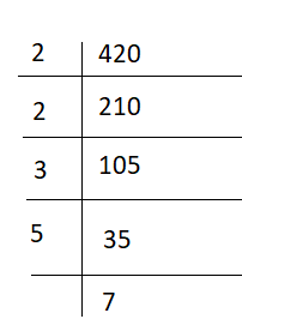 Therefore, 420 = 2 × 2 × × 3 × 5 × 7 i.e, numbers are 2, 3, 4, 5, 6 and 7 Therefore, products is = 2 × 3 × 4 × 5 × 6 × 7 = 5040 Alternate method: Let the numbers be x, x + 1, x + 2, x + 3, x + 4, x + 5 Given that Sum of the first and fourth numbers is equal to the sixth number so, x + x + 3 = x + 5 x = 2 numbers are 2, 3, 4, 5, 6 and 7 Therefore, products is = 2 × 3 × 4 × 5 × 6 × 7 = 5040
More HCF and LCM Questions
- The smallest number which when divided by 29 and 33 leaves remainder 11 and 15 respectively is:
- The square of sum of two numbers is 4,096 and the sum of squares of the same two numbers is 2,176. If their H.C.F. is 8, then find their L.C.M.
- The sum and difference of the L.C.M and H.C.F of two numbers are 540 and 300. If one number is 60, find the other.
- The ratio between three numbers is 7:3:2. Their HCF is given to be 5. Determine the LCM of the numbers.
- Three numbers are in the ratio 2:3:6 respectively. If the HCF of the numbers is 5, then find the LCM of the numbers.
- Which of the following numbers is divisible by 11?
- The HCF and LCM of two natural numbers are 14 and 66, respectively. What is the difference between the two numbers, if one of the numbers is 28?
- The HCF of two numbers is 8 and their LCM is 240. If one number is 40, find the other number.
- The H.C.F of two numbers is 8 and their L.C.M is 136. If one of the numbers is 64, find the other?
- Find the least number that should be added to 90, so that the remainder when divided by 5, 6 and 9 will leave the same remainder 1.
Relevant for Exams:
Hey! Ask a query
Please enter email id
The email must be a valid email address.
Please enter Mobile Number
Please enter valid Mobile Number
Please enter your Doubt

Think You're Ready for RBI Grade B?
RBI Grade B 2026 Phase 1 Memory Based Paper
- 200 Questions with Detailed Solutions
- Section-wise Coverage (GA, English, Quant & Reasoning)