


Question
The ratio of length of two parallel sides is 1 : 3 of a trapezium while non-parallel sides are in the ratio of 2 : 3. If the ratio of length of larger parallel side to the larger non-parallel side is 2 : 1. Find the area of the trapezium. If its height is (15√15)/4 cm?
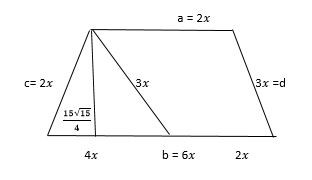
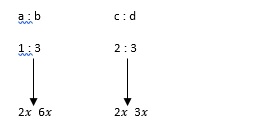 Area of triangle = S = (a+b+c)/2 = (2x+3x+4x)/2 = 9x/2 Area = √(s(s-a)(s-b)(s-c)) = √(9x/2 × s/2 x × 9/2 x × x/2) = (3√15)/4 x² Again area of triangle = 1/2 × 4x × (15√15)/4 Compare both areas 1/2 × 4x × (15√15)/4 = (3√15)/4 x² x = 10 cm ∴ Area of trapezium = 1/2 × (2x + 6x) × (15√15)/4 = 1/2 × 8 × 10 × (15√15)/4 = 150√15 cm²
More Geometry Questions
- If in a ΔABC, the external angle bisector of angle A, meets BC when extended at a point D, BD = 5cm , BC = 3 cm then what is AB:AC ?
- In a ∆ ABC, the angle bisector of ∠A, ∠B, ∠C meet at point I, if ∠AIC is double of equilateral ∆ , then find the ∠ABC =? (in degree)
- If in a ΔABC, AD is internal angle bisector & D is a point on BC, AB = 8 cm, BC = 10 cm then what is BD:CD?
- What is the sum of the smallest and the largest angles of the triangle?
- What is the sum of the supplementary and complementary angles of 60 ° ?
- What will be inradius of an equilateral triangle of side 2 cm?
- Length and breadth of a rectangle are 8 cm and 6 cm respectively. The rectangle is cut on its four vertices such that the resulting figure is a regular oct...
- If I is the incentre of ΔABC , if ∠ BIC = 1200 , then what is the measure of ∠ BAC?
- In a Pentagon ABCDE, ∠A = 110° and ∠B = 140° and ∠D = ∠E. Side AB and DC were extended and meet at the point P such that ∠BPC = 90°. Find the value of ∠E?
- Triangle ABC is similar to triangle PQR and AB : PQ = 2 : 3. AD is the median to the side BC in triangle ABC and PS is the median to the side QR in triangl...
Relevant for Exams:
Hey! Ask a query
Please enter email id
The email must be a valid email address.
Please enter Mobile Number
Please enter valid Mobile Number
Please enter your Doubt

Think You're Ready for RBI Grade B?
RBI Grade B 2026 Phase 1 Memory Based Paper
- 200 Questions with Detailed Solutions
- Section-wise Coverage (GA, English, Quant & Reasoning)