


Question
Find the difference between the number of Veggie burger sold by Farzi and Piccolo and number of Turkey burger sold by Piccolo.
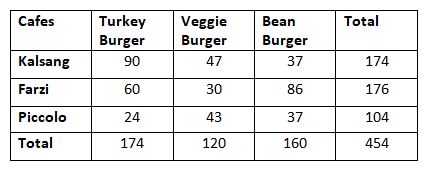 Required difference = (30 + 43) – 24 = 49
 More Caselet DI Questions
- Find the average number of surgical masks sold on Monday and Tuesday.
- Find the average number of Butter cookies baked on Monday, Tuesday and Wednesday together.
- Find the average number of female employees in Marketing, HR and Production departments together.
- Difference between discount offered by Company B and cost of Company A.
- If the boutique decides to offer a discount of 15% on Designer Dresses during a promotional sale and they sell 80 units at this new price, Calculate the pr...
- What is the difference between the total number of male doctor s of hospital A and B together and total number of female doctors of hospital C and D toge...
- Number of male employees in HR department was how much percent more/less than the number of female employees in Marketing department?
- Find the difference between number of silk flowers sold by shop A and B.
- Find the average number of employees in HR, Sales and Operation together.
- What is the ratio of the number of boys participated from school A to the number of girls participated from school C?
Relevant for Exams:
Hey! Ask a query
Please enter email id
The email must be a valid email address.
Please enter Mobile Number
Please enter valid Mobile Number
Please enter your Doubt

Think You're Ready for RBI Grade B?
RBI Grade B 2026 Phase 1 Memory Based Paper
- 200 Questions with Detailed Solutions
- Section-wise Coverage (GA, English, Quant & Reasoning)