


Question
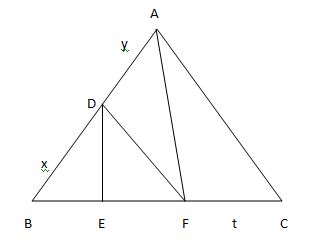
In a triangle ABC, a point D lies on AB and points E and F lie on BC such that DF is parallel to AC and DE is parallel to AF. If BE = 4
In a triangle ABC, a point D lies on AB and points E and F lie on BC such that DF is parallel to AC and DE is parallel to AF. If BE = 4
cm. EF = 6cm. then find the length (in cm) of BC.
More Algebra Questions
- If {x + (1/x)} = 8, then find the value of {x 4 + (1/x 4 )}.
- If x = 8.15, y = 9.06 and z = –17.21, then the value of x³ + y³ + z³ – 3xyz is:
- 4, 10, 19, 30, 43, ?
- What is the HCF of (x³ + 3x² - x - 3) and (x³ + 4x² + x - 6)?
- If 'x' = √10, then find the value of (x - 1)² + (x + 1)²
- If (a + b + c) = 9, find (a – 4)3 + (b – 2)3 + ( c – 3)3 - 3(a – 4 ) (b – 2 ) (c – 3)?
- If (6m – 5n) 2 = 7 and 30mn = 60, then find the value of (6m + 5n) 2 + 16mn.
- If (a + b) = 10 and ab = 21, find the value of (a² + b²).
- If = 3 then = ?
- If = 2 then find
Relevant for Exams:
Hey! Ask a query
Please enter email id
The email must be a valid email address.
Please enter Mobile Number
Please enter valid Mobile Number
Please enter your Doubt

Think You're Ready for RBI Grade B?
RBI Grade B 2026 Phase 1 Memory Based Paper
- 200 Questions with Detailed Solutions
- Section-wise Coverage (GA, English, Quant & Reasoning)