


Question
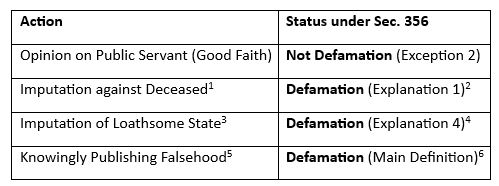
Which of the following is not considered defamation under Section 356 of BNS?
More Other Laws and Acts Questions
- For the purpose of limitation a suit ___.
- An appeal against an order of a STATE Commission lies to the National Commission within which period?
- For the purposes of the Right to Information Act, 2005, a 'PUBLIC AUTHORITY' (Section 2(h)) includes, inter alia:
- Under Section 52(1)(a) of the Copyright Act, 1957, the doctrine of "Fair Dealing" permits use of a copyrighted work without the author's permission for whi...
- Under which Act the Site Appraisal Committee can be constituted?
- Who appoints the Chairperson of LIC?
- What is the punishment for attempting to commit an offence punishable with imprisonment for life or other imprisonment under the Indian Penal Code?
- Any offence committed under SEBI Act which is triable by a Special Court shall, until a Special Court is established, be taken cognizance of and tried by
- Under Section 19(1) of the Right to Information Act, 2005, first appellate authority is:
- Under the Digital Personal Data Protection Act, 2023, the person who determines the PURPOSE and MEANS of processing personal data is termed the:
Hey! Ask a query
Please enter email id
The email must be a valid email address.
Please enter Mobile Number
Please enter valid Mobile Number
Please enter your Doubt

Think You're Ready for RBI Grade B?
RBI Grade B 2026 Phase 1 Memory Based Paper
- 200 Questions with Detailed Solutions
- Section-wise Coverage (GA, English, Quant & Reasoning)