


Question
An object moves towards a convex lens of focal length 20 cm with a velocity of 5 cm/s. When the object is at 30 cm from the lens, find the rate at which the image is moving.
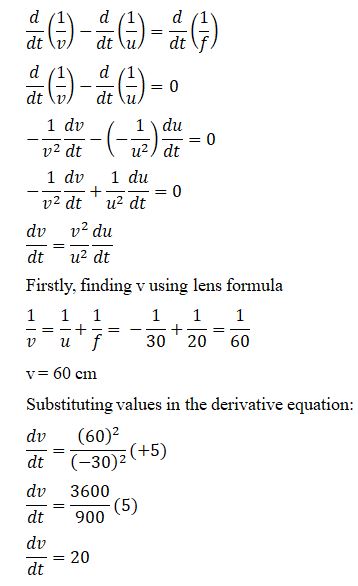 The image is moving away from the lens at a rate of 20 cm/s.
 More Physics GS Questions
- Match the following machines with their working principles: (i) Electric motor - (a) Heat energy into mechanical energy (ii) Steam engine - (b) Electric ...
- When a capacitor is fully charged in a DC circuit, the current through it is:
- During ______ motion of an object along a straight line, the change in velocity of the object for any time interval is zero.
- The balance point in a potentiometer for a cell of emf 1.5 V is 60 cm. If a resistance of 5 Ω is connected in parallel with the cell and the new balance po...
- The material used in the fabrication of a transistor is –
- A capacitor of 4 µF is charged to 100 V. It is then connected across an uncharged 2 µF capacitor. Final common voltage is:
- Who laid the foundations of Quantum Theory?
- The mass density of Kerosene is:
- What type of rays are used in a CT scan to visualize the internal structures of the human body?
- A particle is fired with initial speed 30 m/s and lands back at same horizontal level. If its horizontal range is equal to 4.5 times the vertical height re...
Relevant for Exams:
Hey! Ask a query
Please enter email id
The email must be a valid email address.
Please enter Mobile Number
Please enter valid Mobile Number
Please enter your Doubt

Think You're Ready for RBI Grade B?
RBI Grade B 2026 Phase 1 Memory Based Paper
- 200 Questions with Detailed Solutions
- Section-wise Coverage (GA, English, Quant & Reasoning)