


Question
Suppose two distributions have the same mean, same standard deviation and are equally skewed, but the first distribution is more peaked than the other. This feature of the frequency distributions in which they are different are called
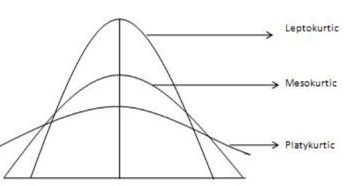 Mesokurtic : This distribution has kurtosis statistic similar to that of the normal distribution. It means that the extreme values of the distribution are similar to that of a normal distribution characteristic. This definition is used so that the standard normal distribution has a kurtosis of three. Leptokurtic (Kurtosis > 3) : Distribution is longer, tails are fatter. Peak is higher and sharper than Mesokurtic, which means that data are heavy-tailed or profusion of outliers. Outliers stretch the horizontal axis of the histogram graph, which makes the bulk of the data appear in a narrow (“skinny”) vertical range, thereby giving the “skinniness” of a leptokurtic distribution. Platykurtic: (Kurtosis < 3 ): Distribution is shorter, tails are thinner than the normal distribution. The peak is lower and broader than Mesokurtic, which means that data are light-tailed or lack of outliers. The reason for this is because the extreme values are less than that of the normal distribution.
More Alternate Sources of Finance Questions
- Under the RBI’s guidelines for import of gold by Tariff Rate Quota (TRQ) holders, how many days of advance payment are allowed for Qualified Jewellers?
- How many stressed accounts have been identified for transfer to NARCL (National Asset Reconstruction Company Limited) in a phased manner initially
- RBI created Payments Infrastructure Development Fund (PIDF) which intends to subsidise deployment of payment acceptance infrastructure in the country. The ...
- If the budgeted production units were 500 and the budgeted material required was 1000. Actual material used up is 800 units for the output of 350 units. He...
- Share split transactions involves the …….. of issued shares of a company into a ………. number of shares without any further consideration from the shareholde...
- W hat percentage of the projected annual turnover is typically used to calculate the working capital requirement , u nder the Simplified Turnover Method?
- Financial Instruments such as Call Money, Collateral Loans, Bills of exchange, T-Bills, CoD forms an integral part of ?
- From a machine that cost Rs.50,000 and has residual value of zero the following costs and revenues are expected to be derived over its life of 4 years: ...
- While accounting for ‘interest on capital’ provided by a firm, it will be recognized as which of the following?
- An effective MIS (Management Information System) should have all the features, except?
Hey! Ask a query
Please enter email id
The email must be a valid email address.
Please enter Mobile Number
Please enter valid Mobile Number
Please enter your Doubt

Think You're Ready for RBI Grade B?
RBI Grade B 2026 Phase 1 Memory Based Paper
- 200 Questions with Detailed Solutions
- Section-wise Coverage (GA, English, Quant & Reasoning)