


Question
Which of the following sets of financial criteria must a Navratna company meet over the last three years to be eligible for the grant of Maharatna status?
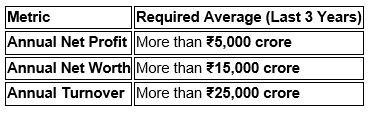 Note: Option C correctly identifies these specific thresholds. Other Essential Criteria Financials alone aren't enough. The company must also meet these institutional requirements:
 More Research Questions
- Let the utility function of a consumer be given by U(x,y) = min {y+2x, x+2y}. Prices are given by Px=1, Py=3, while the consumer’s income is M=20. Then her...
- 'Hedging' in derivative markets is best described as:
- Ed=1 i. MR is negative Ed>1 ii. MR=0 Ed<1 iii. MR is positive
- NBFC Deposits are added in which of the following?
- In the Solow neoclassical growth model, aggregate output growth can be decomposed into contributions from capital accumulation, labor input, and a residual...
- If f(x) is continuous for all real values of x and f(x) takes on only rational values, then if f(1)=1, the value of f(0) is
- What is the Fiscal deficit budgeted for 2024-25 as per the Union budget?
- In the foreign exchange market price of US Dollar rises from ₹ 60 to ₹ 61. This means that_____
- Lorenz Curve is given by: L(x) = 1/3 (X^3) + 2/3 (x^5). Calculate Gini Coefficient.
- Arrange the following milestones in the history of the European Union in the correct chronological order (from earliest to most recent): I. The signing of...
Hey! Ask a query
Please enter email id
The email must be a valid email address.
Please enter Mobile Number
Please enter valid Mobile Number
Please enter your Doubt

Think You're Ready for RBI Grade B?
RBI Grade B 2026 Phase 1 Memory Based Paper
- 200 Questions with Detailed Solutions
- Section-wise Coverage (GA, English, Quant & Reasoning)