


Question
Assertion (
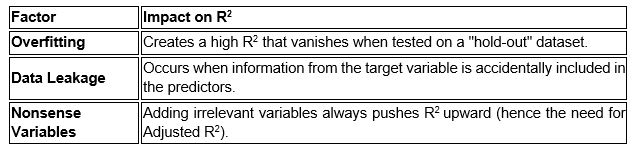
- A : A very high R2 value (e.g., 0.98) in a multiple linear regression model always indicates that the model is highly effective for predicting future outcomes and that the chosen independent variables are the true causes of the dependent variable. Reason (
- R : R2 can be artificially inflated by adding more independent variables to the model, regardless of their actual relevance, or by the presence of data issues like multicollinearity and overfitting. Choose the correct option:
More Research Questions
- Suppose the money supply in Mexico grows more quickly than the money supply in the USA. We would expect that
- The equation of a random walk model WITHOUT drift is best represented as:
- For the regression specification y = α + βx + ε the OLS estimates result from minimizing the sum of
- According to the neoclassical growth model, which of the following statements is false ?
- The 'Dornbusch Overshooting Model' explains why exchange rates are more volatile than fundamental economic data by assuming that:
- Consider a bargaining game: Find pure strategy Nash equilibrium.
- If the economy is operating at point C, the opportunity cost of producing an additional 20 units of bacon is
- What will be the value of P(not E) if P(E) = 0.07?
- Type II error occurs when
- List – I List – II a. Kinked demand curve hypothesis 1. William Baumol b. Sales maximization model of oligopoly 2. Paul Sw...
Hey! Ask a query
Please enter email id
The email must be a valid email address.
Please enter Mobile Number
Please enter valid Mobile Number
Please enter your Doubt

Think You're Ready for RBI Grade B?
RBI Grade B 2026 Phase 1 Memory Based Paper
- 200 Questions with Detailed Solutions
- Section-wise Coverage (GA, English, Quant & Reasoning)