


Question
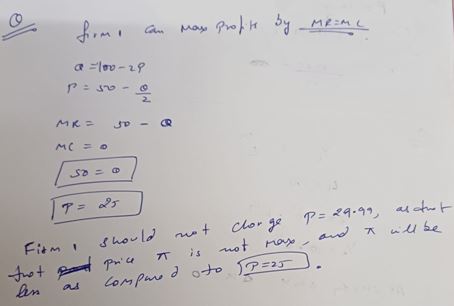
Two duopolist firms, 1 and 2, sell a homogeneous good in a market with the demand function Q=100−2P, where Q is the quantity demanded at price P. Firms 1 and 2 have constant marginal costs of 0 and 30, respectively. The firms simultaneously announce prices, and consumers buy from the firm whose price is lower. If the firms choose the same price, all the consumers buy from firm 1. Firm 1's equilibrium price is:
More Research Questions
- Consider the following: Statement 1: There exists an inverse relationship between market rates of interest and price of bond Statement 2: The liquidity t...
- Park Test is used for which of the following?
- Question 3
- Which of the following could be a remedy for Multicollinearity Problem?
- Given: • Exports (X) = 300 • Imports (M) = 200 Calculate the Intra-Industry Trade (IIT) Index, also known as the Grubel-Lloyd Index.
- As part of its medium-term fiscal consolidation strategy outlined in the Union Budget 2026–27, the Central Government has indicated a target for reducing i...
- The index of import prices stands at 150 and that of exports is 180. What is the terms of trade
- In which of the following models, price is driven down to marginal cost?
- Autocorrelated errors is about
- Suppose X is a continuous random variable with probability density function: f(x) = 3x² for 0 ≤ x ≤ 1 and: f(x) = 0 elsewhere. Calculate the variance o...
Hey! Ask a query
Please enter email id
The email must be a valid email address.
Please enter Mobile Number
Please enter valid Mobile Number
Please enter your Doubt

Think You're Ready for RBI Grade B?
RBI Grade B 2026 Phase 1 Memory Based Paper
- 200 Questions with Detailed Solutions
- Section-wise Coverage (GA, English, Quant & Reasoning)