


Question
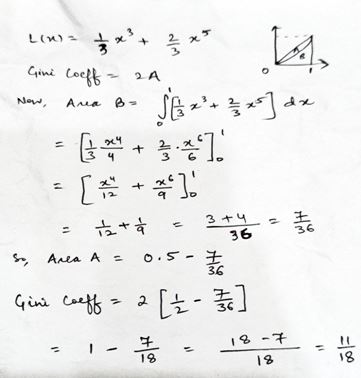
Lorenz Curve is given by: L(x) = 1/3 (X^3) + 2/3 (x^5). Calculate Gini Coefficient.
More Research Questions
- Which of the following sets of financial criteria must a Navratna company meet over the last three years to be eligible for the grant of Maharatna status?
- Net Domestic Product at Market Price (NDPₘₚ) and Net Domestic Product at Factor Cost (NDP𝒻𝒸) will be equal when:
- The Fisher Effect assumes that the
- IPO of which government owned company is scheduled in this year FY 22?
- In cluster sampling:
- Elistan can produce either 5 monster trucks or 10 cans of silly string in a day. What is the opportunity cost of one can of silly string?
- In a study examining the relationship between hours of study (X) and test scores (Y) of students, a bivariate regression analysis was conducted. The follow...
- A 'Non-Banking Financial Company-Investment and Credit Company (NBFC-ICC)' is primarily involved in:
- The substitution effect for a commodity is
Hey! Ask a query
Please enter email id
The email must be a valid email address.
Please enter Mobile Number
Please enter valid Mobile Number
Please enter your Doubt

Think You're Ready for RBI Grade B?
RBI Grade B 2026 Phase 1 Memory Based Paper
- 200 Questions with Detailed Solutions
- Section-wise Coverage (GA, English, Quant & Reasoning)