


Question
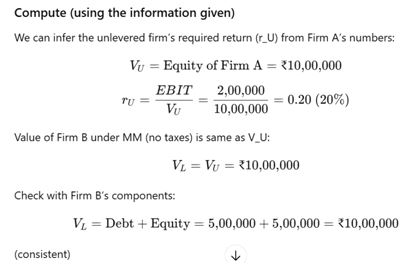
Two firms, Firm A and Firm B, are identical in all respects except their capital structure. • Firm A (Unlevered): It is entirely equity financed with equity capital of ₹10,00,000. • Firm B (Levered): It has equity capital of ₹5,00,000 and debt capital of ₹5,00,000, carrying an interest rate of 10% per annum. • The expected EBIT of both firms is ₹2,00,000. • Assume there are no corporate taxes and capital markets are perfect. You are required to calculate the value of both firms under the Modigliani and Miller (M
- M Approach (No Taxes) and briefly state the principle underlying your result.
More Financial Statement Analysis Questions
- A company discloses only minimum required financial information despite having significant related party transactions. Which principle is being compromised...
- An interest-bearing deposit received by a bank for a fixed period, where the proceeds are earmarked for allocation towards green finance, is known as a:
- A company reports Current Assets ₹6,00,000, Current Liabilities ₹3,00,000, Inventory ₹1,20,000, Cash ₹60,000. What is the company’s Quick Ratio?
- If company's operating cycle (inventory days + receivables days) = 120 days and payables days = 40 days, cash conversion cycle = ?
- A firm’s EBIT is ₹20 lakh and interest is ₹5 lakh. What is interest coverage ratio?
- A firm evaluates two projects with identical expected cash flows, but Project A has higher variability. If the firm is risk-averse, what would be its decis...
- A company has Net Sales of ₹1,000 lakhs, Net Profit of ₹80 lakhs, Total Assets of ₹750 lakhs, and Equity of ₹250 lakhs. Calculate Return on Equity (ROE) u...
- If a stock has a Beta equal to 0, its expected return according to CAPM will be equal to:
- Debt Equity Ratio 2:1; Total Assets ₹15,00,000; Equity = ?
- Refer the following summarized Balance Sheet of Roy Ltd. as on 31‐3‐2023: Additional Information: Operating expenses for the year 2023 amounted to Rs. 15,...
Hey! Ask a query
Please enter email id
The email must be a valid email address.
Please enter Mobile Number
Please enter valid Mobile Number
Please enter your Doubt

Think You're Ready for RBI Grade B?
RBI Grade B 2026 Phase 1 Memory Based Paper
- 200 Questions with Detailed Solutions
- Section-wise Coverage (GA, English, Quant & Reasoning)